In short
- Start at the edges and corners. A pipe can never point off the board, so border tiles have very few ways to sit.
- Two dead ends never point at each other, and the finished network never has a loop.
- Lock every tile you are sure about. Locking is free and stops stray taps.
- Par is the fewest turns from the scramble. Undo takes a turn back off your count, so use it instead of spinning a tile all the way round.
The basics
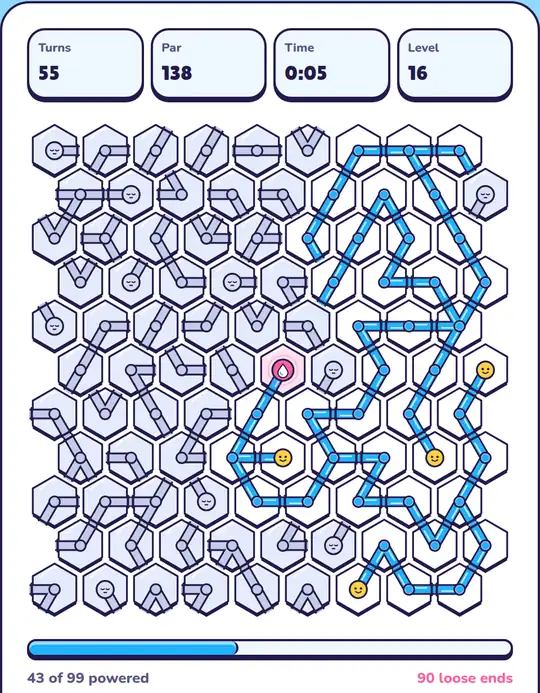
Every hexagon on the board holds a piece of pipe. The source, a pink water tank with a droplet, sits in the middle. Water flows from it through any two pipes that point straight at each other. Tiles the water reaches turn bright and fill with blue. Tiles it can't reach stay grey.
You win when every tile is powered and there are no loose ends. A loose end is any pipe stub that has nothing to join: it points at a neighbour that isn't pointing back, or off the edge of the board. The bar under the board keeps score for you: "12 of 25 powered" on the left and the number of loose ends on the right.
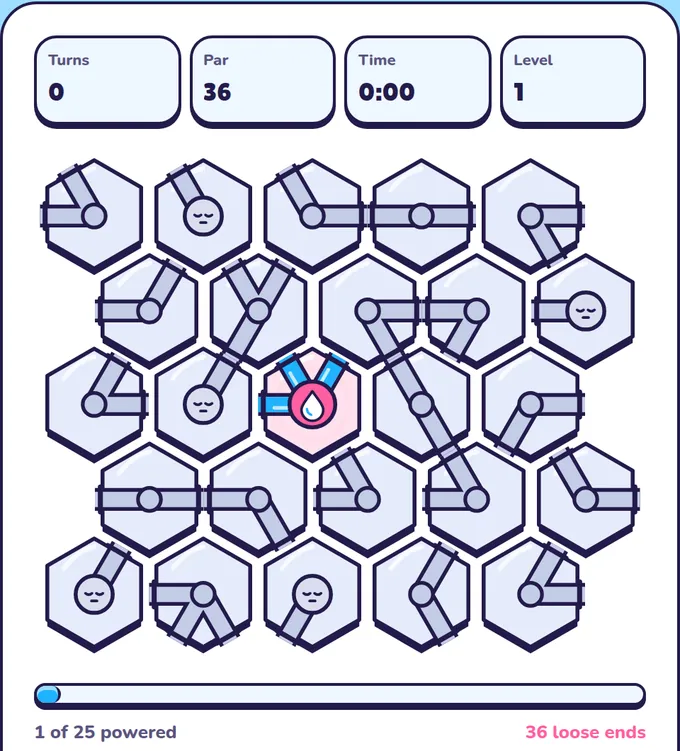
| Easy (levels 1–3) | 5 × 5 board, 25 tiles |
|---|---|
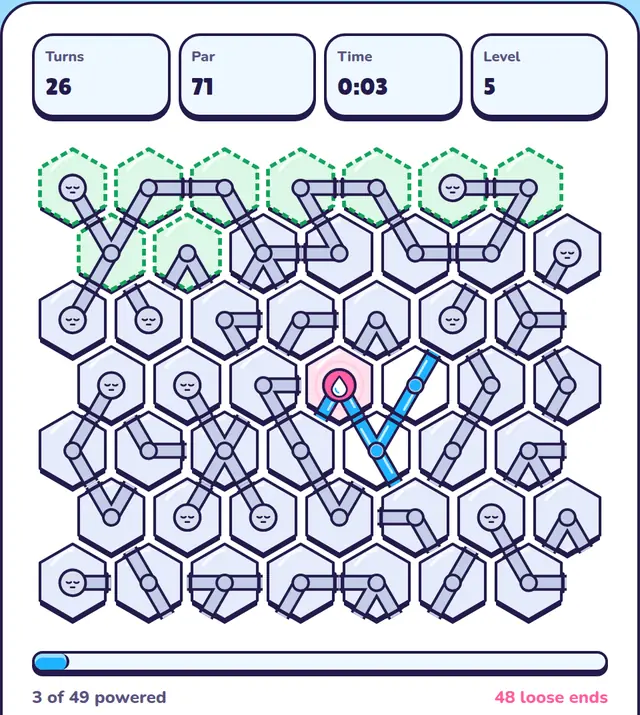
| Medium (levels 4–8) | 7 × 7 board, 49 tiles |
| Hard (levels 9–14) | 8 columns × 9 rows, 72 tiles |
| Expert (level 15 on) | 9 columns × 11 rows, 99 tiles |
Bigger boards also have longer, more winding pipe runs.
The tiles
A hexagon has six sides, so a pipe can leave a tile in up to six directions. The shapes you will meet:
- Dead ends: a single stub with a sleepy face. It wakes up and smiles when the water reaches it. Between a sixth and a third of all tiles are dead ends.
- Straights: two stubs on opposite sides.
- Sharp bends: two stubs on neighbouring sides, a tight V.
- Wide bends: two stubs with one side between them, a gentle curve.
- Junctions: three stubs, in four different arrangements, including the symmetric Y. Four-way and five-way tiles exist but are rare.
The source is a tile too. It turns like any other, so don't assume its pipes already face the right way.
Turning, turns and par
Tap or click a tile to turn it one sixth of a circle clockwise. With a keyboard or mouse, shift-click (or Shift+Enter) turns it anticlockwise. Arrow keys move between tiles and Enter turns the one you are on. Each step counts as one turn, shown at the top as Turns.
Par is the smallest number of turns that solves the board from the scramble, turning each tile whichever way round is shorter. So no tile ever costs more than three turns. A straight looks the same after half a turn, so it is never more than one turn from right, and the same goes for the Y junction. Par runs from about 20 to 50 on Easy boards and well over 100 on Expert.
On a touchscreen there is no anticlockwise turn, so a tile that sits one step anticlockwise of right costs five taps. If you overshoot, press Undo (or U): an undone turn comes off your count, while spinning on round counts every step.
Solve from the edges in
The edge of the board is your best friend, because no pipe may point off it. Every board is grown so that the solution has no loose ends, so any orientation that points outwards is simply wrong.
- Left-hand corners touch only two neighbours (east and south-east at the top, east and north-east at the bottom). A tile there must be a dead end or a sharp bend, and a sharp bend fits exactly one way.
- Straights on the top or bottom row can only lie flat along the edge. A Y junction can never sit on the top or bottom row at all.
- The right-hand corners touch three neighbours, so they are slightly looser but still tight.
Once a border tile is fixed, it tells its neighbours something: "I point at you, so you must point back" or "I don't, so you mustn't". Work inwards one tile at a time, always asking which orientations still agree with every settled neighbour. When we ran exactly this logic on hundreds of generated boards, it settled about 98 tiles in every 100 on Easy and more than 99 in 100 on larger boards, before any guessing at all.
Two rules that break ties
Every solution is a single tree branching out from the source, which gives you two more rules:
- Dead ends never face each other. Two dead ends joined together make a closed pair that can never reach the source.
- No loops. If an orientation would close a ring of pipes, it is wrong somewhere, because a tree with every tile in it has no spare connections.
And every group of tiles must connect back to the source, so a region sealed off on all sides needs one of its boundary tiles to open outwards.
Lock what you know
Right-click a tile, press and hold it on a touchscreen, or press L, to lock it. A locked tile gets a green dashed outline and refuses to turn. If you tap it by mistake, it shakes and tells you it is locked. Locking costs no turns, so lock freely: everything without a lock is still open to question. Reset clears all locks.
Don't confuse "powered" with "correct". A perfectly turned tile stays grey until the path to it is finished, and a lit tile can still point a stub the wrong way. The loose-end count is the honest measure.
Common mistakes
- Chasing the light from the middle. The source is the least constrained place on the board. Edges first, source last.
- Turning tiles to "see what happens". Every step counts. Decide first, then turn.
- Forgetting the source turns. It is often the last tile to settle.
- Forgetting the side edges. Alternate rows are shifted half a hexagon, so many tiles on the left and right edges touch only three neighbours.
Hints, undo and reset
You get three hints per board. A hint turns one wrong tile into its solved position the short way round, choosing a tile next to the powered area where it can. The hinted turns count like any others. Undo steps back one turn, Reset (R) returns to the scramble, and New puzzle (N) deals a fresh board. Occasionally a board can be closed in more than one way; the game checks the rules, not a stored answer, so any complete network wins.
Ranked play and the leaderboard
When the game can reach the server, the board is marked Ranked. The server picks the board and starts its own clock. When you finish, your browser sends the list of turns you made, never a score or a time, and the server replays them on its own copy of the board to confirm the network really is complete. Your count is the total number of steps in that list. A solve that used a hint stays off the leaderboard, and a ranked board expires after two hours.
The leaderboard ranks players by their fastest verified time, with a separate table for each difficulty and for each day's daily puzzle. Points are added on top:
| Base points | Easy 100, Medium 220, Hard 460, Expert 800. Each level above 1 adds 4%, up to double at level 26. |
|---|---|
| Speed bonus | Up to +50%, in full when you finish in half the target time (25 seconds on Easy, 1 minute on Medium, 2½ on Hard, 4 on Expert). Nothing at or beyond the target, but never a penalty. |
| Efficiency bonus | Up to +40%. Exactly par earns about +27%. It falls to nothing at one and a half times par. |
| Daily puzzle | +25%, plus 2% for each day of your streak, up to +20%. |
Levels and the daily puzzle
Clearing a level unlocks the next, and each attempt deals a fresh board, so there is nothing to memorise. After a clear you turn over one of three face-down cards for a bonus, such as extra hints or a few turns played for you next time. The daily puzzle is one board for everyone that day. Your record panel counts par solves: boards finished at or under par without hints.
Ready to try the edge-first method? It's free and runs in your browser.
Play Hexflow