In short
- A tap raises charge by one, and the top value rolls back round to zero. A high number is nearly done.
- Order never matters. Only how many times each cell is tapped counts, so plan first.
- Chase the lights: clear each row by tapping the cell directly below each lit cell. On Easy this always works.
- On Medium and Hard, the only real decisions are the top row and the round cross nodes. The chase does the rest.
The basics
The board is a square grid of nodes, each holding a charge. You win when every node is at zero (a plain pale square). Tap a node to pulse it. On a desktop, hovering outlines every cell a pulse will reach.
| Easy (levels 1–3) | 4 × 4 grid. Nodes are simply on or off. No cross nodes. |
|---|---|
| Medium (levels 4–8) | 5 × 5 grid, charges 0 to 2, two cross nodes. |
| Hard (levels 9–14) | 6 × 6 grid, charges 0 to 2, four cross nodes. |
| Expert (level 15 on) | 6 × 6 grid, charges 0 to 3, five cross nodes, and the edges wrap round. |
Every board starts with more than a third of its nodes charged.
What a tap does
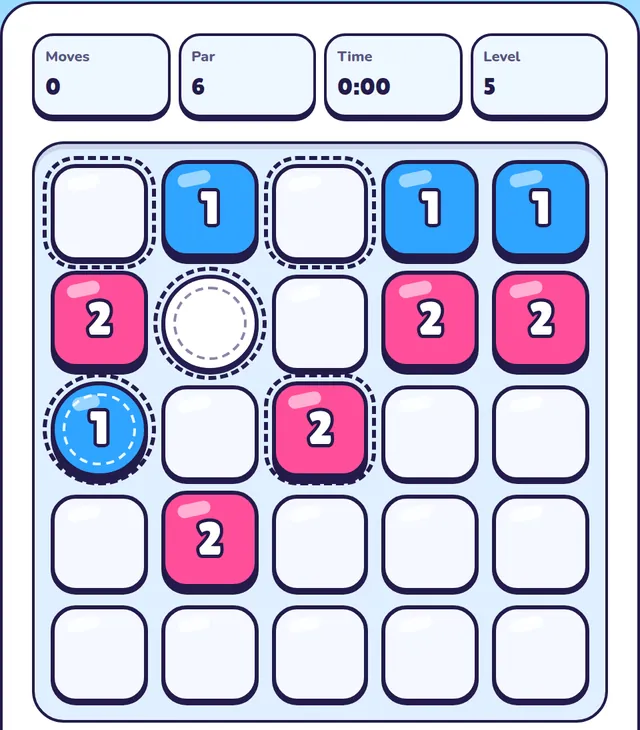
A pulse adds one to the charge of a group of nodes. When a node is already at its top value (1 on Easy, 2 on Medium and Hard, 3 on Expert), the pulse rolls it back to zero. Which nodes are in the group depends on the node you tap:
- Plus nodes (ordinary squares) pulse themselves and the four nodes beside them: up, down, left and right.
- Cross nodes (round, with a dashed ring) pulse themselves and their four diagonal neighbours instead.
- At the edges, anything that would fall off the grid is simply skipped, so a plus node in a corner pulses only three cells.
- On Expert, nothing is skipped: a pulse that goes off one edge comes back in on the opposite side.
Read the numbers backwards
Because taps only add charge, the useful number is how many more pulses a node needs to roll round to zero. On Medium and Hard a 2 needs one more pulse and a 1 needs two. On Expert a 3 needs one, a 2 needs two and a 1 needs three. The biggest numbers are the closest to finished.
Why tap order never matters
Each tap adds one to a fixed set of nodes, whatever is on the board. Adding gives the same total in any order, so the final board depends only on how many times you tapped each node, not when. And tapping a node as many times as there are charge values (twice on Easy, three times on Medium and Hard, four times on Expert) adds a full lap to every node it touches, which changes nothing.
We confirmed it with the game's own code: random tap sequences, replayed in shuffled order, always ended on the same board. So a solution is just a count for each node, and you can never get stuck, because any tap can be cancelled by finishing its lap.
How par is set
Every board is built backwards from a known answer. The game picks a few different nodes, decides how many times each one should be tapped, and works out the board those taps would clear. Par is the total number of taps in that answer:
| Easy | 4 nodes, once each, so par is always 4. |
|---|---|
| Medium | 6 nodes, once or twice each: par 6 to 12. |
| Hard | 10 nodes, once or twice each: par 10 to 20. |
| Expert | 10 nodes, one to three times each: par 10 to 30. |
Treat par as the real minimum: solving thousands of boards exactly, we found par beaten only once, on one Expert board in 1,500. Other answers of the same length exist, especially on Easy, and any of them wins.
The reliable method: chase the lights
Start with the top row. For every charged node in it, tap the plus node directly below as many times as the top node needs. That pulse reaches the node above but nothing else in the top row, so the row clears and stays clear. Repeat for each row in turn, pushing everything down to the bottom row.
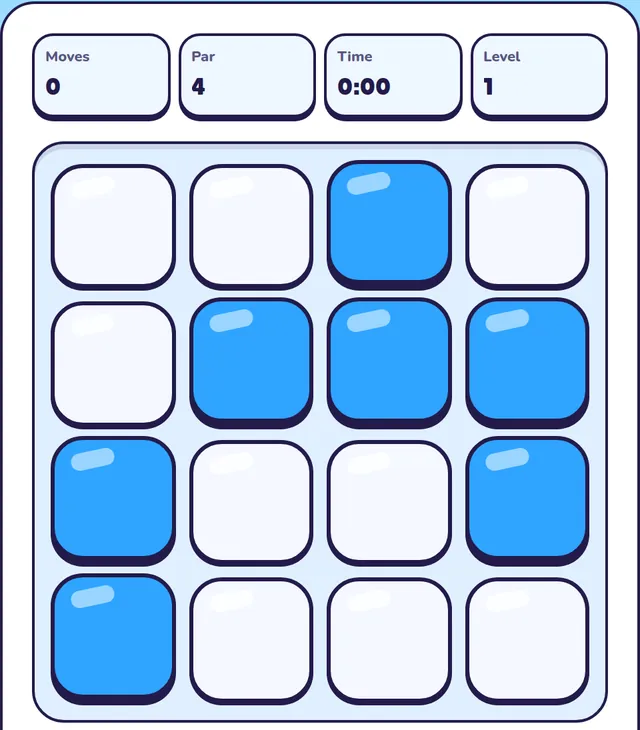
Here is the chase on the board above:
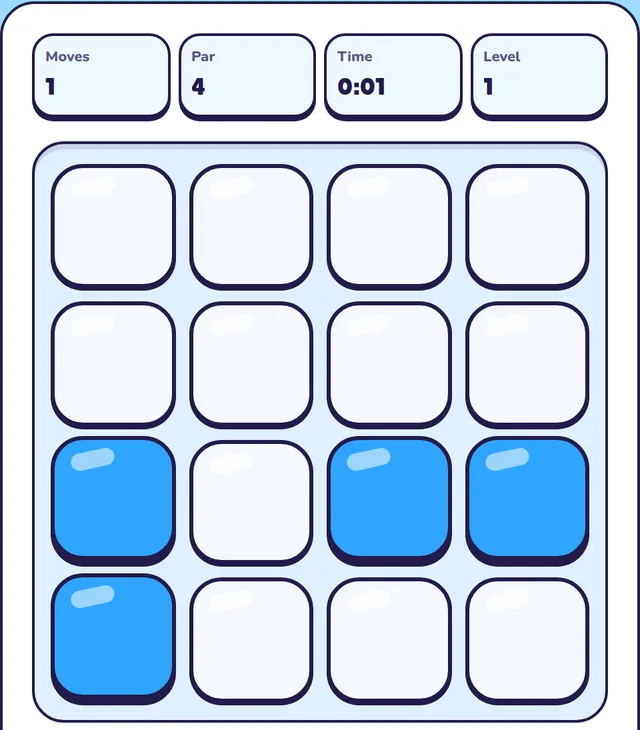
- Row 1 has one light, in column 3. Tap row 2, column 3. It switches off that light and the three in row 2, and switches on row 3, column 3.
- Row 3 now has lights in columns 1, 3 and 4. Tap row 4, column 1. That clears row 3, column 1 and flips row 4, columns 1 and 2.
- Tap row 4, column 3, then row 4, column 4. The last lights go out.
Four taps, exactly par, though the game's own answer used four different nodes. On Easy the chase always finishes: it cleared all 2,000 Easy boards we tried, sometimes a couple of taps over par.
When cross nodes get in the way
On Medium and Hard, sometimes the node below a lit cell is a cross node, which can't reach the cell directly above it, and leftovers pile up at the bottom. The fix is to make the real decisions before you chase: how many times to tap each top-row node and each cross node. Once those are fixed, every other tap is forced by the chase. We tried every combination on hundreds of Medium boards and dozens of Hard ones: one always finished the board, and the best one landed exactly on par.
In practice: chase once and look at what is left. Then press Reset, give one top-row node or cross node one or two pulses, and chase again. Effects add up, so you can combine adjustments that helped. In our tests a plain chase finished about one Medium board in seven. Adjusting one well-chosen node first finished about half of them, and adjusting two finished nearly nine in ten.
On Expert the edges wrap, so pulses on the bottom row spill into the top row and there is no clean place to start. The same idea still works if you treat the first two rows and the cross nodes as your decisions and chase from the second row down. Expect to use Undo more here.
Common mistakes
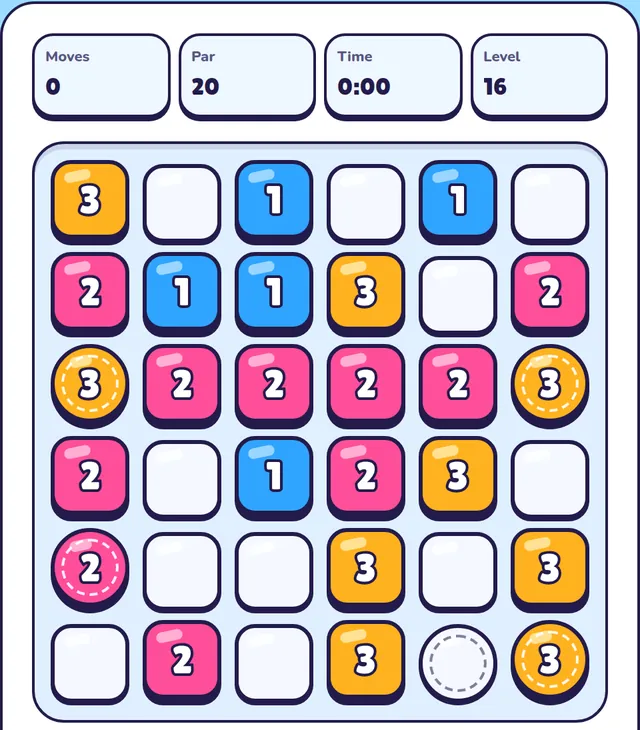
- Tapping the highest number to "bring it down". Taps only go up. A 3 on Expert wants one pulse, not three.
- Treating cross nodes like plus nodes. Look for the dashed ring.
- Undoing a long wrong path by hand. Reset is quicker and clears your move count.
Hints, undo and reset
Each board comes with three hints. A hint highlights one node and tells you how many more pulses it needs. It doesn't tap for you. Hints stay correct even after wrong taps, because they are worked out from the counts you have made so far. Undo (Ctrl+Z or Cmd+Z) takes back your last tap and Reset returns to the start. H asks for a hint and N for a new puzzle.
Ranked play and the leaderboard
When the game can reach the server, the board is marked Ranked: the server deals it and starts its own clock. When you win, your browser sends your taps, never a score or a time, and the server replays them to confirm every node is at zero. It counts the taps on each node net of full laps, so wasted laps cost time but no points. Any hint keeps the solve off the board, and ranked boards expire after two hours. The leaderboard ranks your fastest verified time, by difficulty and for each day's daily puzzle.
| Base points | Easy 100, Medium 220, Hard 460, Expert 800, plus 4% for each level above 1, up to double at level 26. |
|---|---|
| Speed bonus | Up to +50%, in full at half the target time (25 seconds Easy, 1 minute Medium, 2½ Hard, 4 Expert). No penalty for being slow. |
| Efficiency bonus | About +27% at exactly par, falling to nothing at one and a half times par. |
| Daily puzzle | +25%, plus 2% a day for your streak, up to +20%. |
Clearing a level unlocks the next, each attempt deals a fresh board, and after a clear you turn over a bonus card, such as extra hints. The daily puzzle is the same grid for everyone.
Ready to chase some lights? It's free and runs in your browser.
Play Fluxgrid