In short
- You move before the fire spreads, so a square outlined to burn next turn can still be saved by digging it now.
- Grass burns at once, forest takes an extra turn. Dig the grass first and let the trees wait.
- Rock, water and the map edge are free walls. Find the narrowest gap between them and dig there.
- Firebreaks do not block the cat, but burnt ground does. Keep the fire off the cat's road.
The basics
A fire has started, the house is in danger and the cat is still out. Every turn has three steps, always in this order:
- You do one thing: dig a firebreak on a square of grass, forest or a sunflower, throw a bucket of water on a burning square, or wait.
- The cat takes one step towards the house.
- The fire spreads.
When nothing is left burning, the map is over. You win if the house and the cat are both unburnt; you lose the moment the fire reaches the house or the square the cat is standing on.
How each square burns
| Grass | Catches as soon as a neighbouring square is burning. Fire crosses open grass one square per turn. |
|---|---|
| Forest | Needs two lots of heat: one burning neighbour for two turns, or two burning neighbours at once. Heat is never forgotten, and a tree that has had one lot glows orange. |
| Sunflowers and the house | Burn just like grass. |
| Rock, water, firebreaks | Never burn. |
| Burning squares | Burn for two spreads, heating their four neighbours (not diagonals) each time, then turn to ash. Ash never burns again. |
The practical rule: forest buys you one turn at most. A tree next to the fire is not safe, it is just slower. Because a burning square heats its neighbours on two spreads, a single burning neighbour is enough to light a tree eventually.
The map shows you what is coming. A yellow dashed outline means "this square burns at the end of this turn if you do nothing". A red dashed outline means embers will land there (see wind, below). Paw prints show the cat's road home.
A worked example
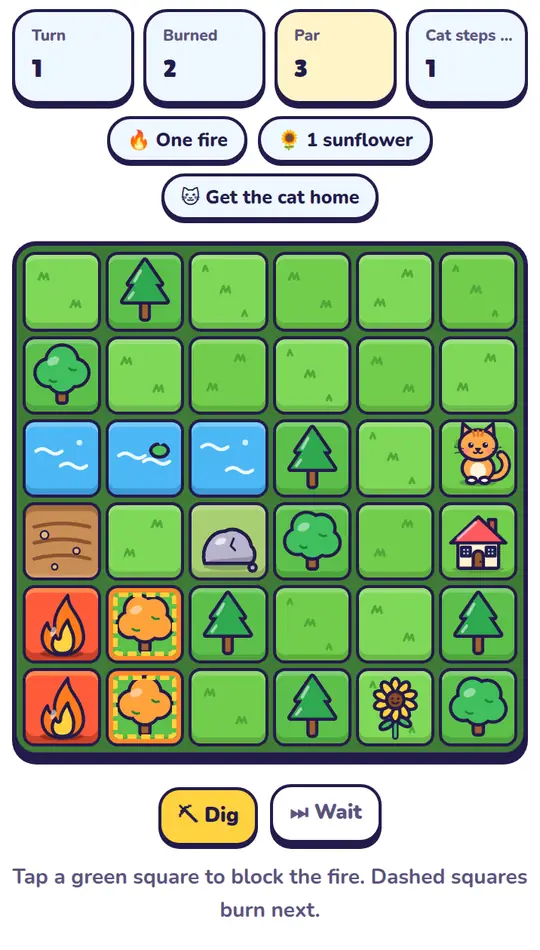
Take the map above. Two squares are burning in the bottom-left corner, with a row of water two squares above. The water, the rock and the map edge already hem the fire in. Its only ways out are the grass square directly above it and the two trees to its right.
- Turn 1: dig the grass above the fire. Grass catches at once, so this is the most urgent square. The two trees each take one lot of heat.
- Turn 2: dig the upper tree. It is warm and would catch this turn. The lower tree catches, which is fine: its only unburnt neighbour left is one grass square.
- Turn 3: dig the grass to the right of the burning tree. Now every way out is closed.
Only three squares burn, which matches par, for three stars. Start with the upper tree instead and the grass above the fire catches on turn 1. The best you can do from there is four burnt squares: still a rescue, but two stars. Same idea, wrong order.
Real technique
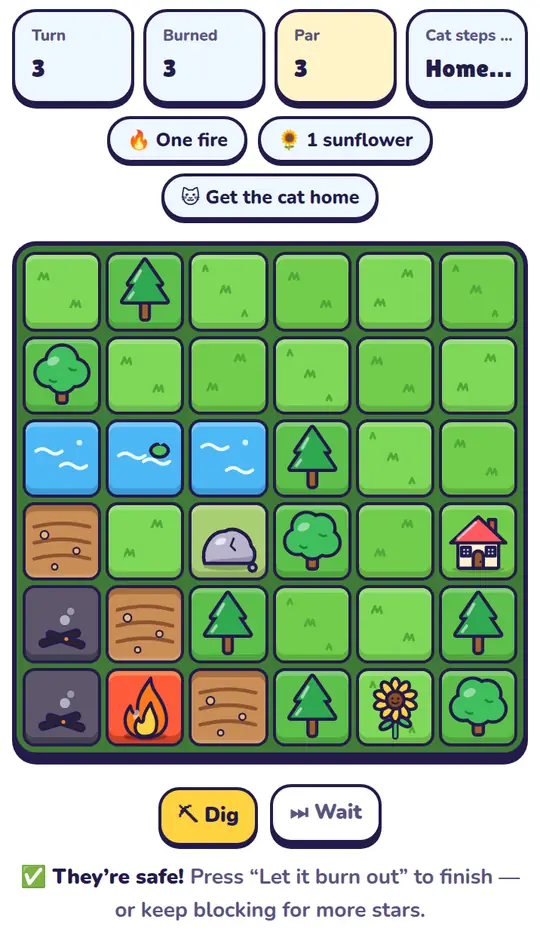
- Cut at the choke point. Look for the narrowest gap between rock, water and the map edge on the fire's way to the house. A wall across a two-square gap is quicker to finish than a ring around the house, and it lets far fewer squares burn.
- Dig in order of danger. Grass with a yellow outline first, then grass the fire reaches next turn, then trees. Never spend a turn on a square the fire cannot reach in time to matter.
- Wall close, not far. Stars count burnt squares, so the closest wall you can still finish in time is the best one. The squares you dig do not count as burnt.
- Leave the sunflowers. You can dig a sunflower, but it then becomes a plain firebreak and is no longer saved for bonus points. Dig the grass beside it instead.
- Keep going when it says safe. Once the house and cat can no longer be reached, a "Let it burn out" button appears. Before pressing it, look for more digs that keep extra squares from burning. That can be the difference between two and three stars.
The cat's walk home
The cat walks by the shortest road it can over grass, forest, sunflowers and firebreaks. It never crosses water, rock, fire or ash, and you cannot dig the square it stands on. Since firebreaks are walkable, you can dig straight across the cat's road without slowing it down.
What you must not do is let the fire cross the road. A burnt square stays blocked for good, and if every road is cut the cat simply sits and waits, while the fire may come to it. The HUD counts the cat's steps home, and says Stuck when no road is left. On many maps the safest plan is to protect the road for the first few turns so the cat gets home early; after that, only the house needs saving.
Wind and embers
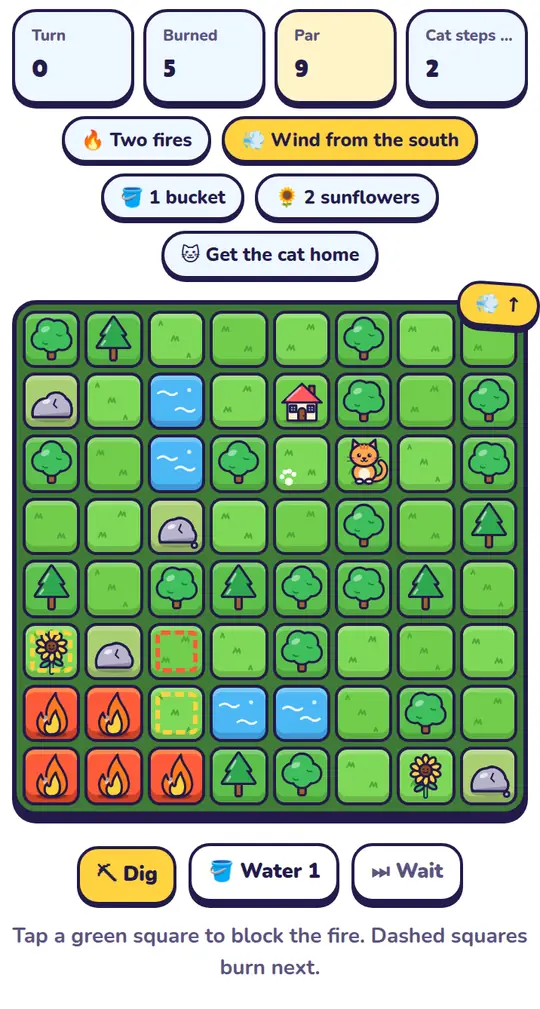
On windy levels a chip at the top tells you where the wind blows from, and an arrow on the map points the way the embers fly. Every burning square throws embers two squares downwind. They fly over anything except rock, and they light grass, sunflowers, the house or the cat where they land. Trees are too green to catch from embers.
That changes your walls. Downwind, a fire can jump two squares of grass a turn, and a single firebreak is not enough because the embers sail straight over it. On the downwind side, build a wall two squares thick, or put your single firebreak where the square behind it is a tree, a rock or water.
Water buckets
From the Medium levels on, you get a bucket or two. Pick Water and tap a burning square: it goes out at once and turns to ash before it can spread again. A doused square already counted as burnt, so water never adds to your total. Use it on a burning square that is about to reach the house or the cat, or to plug a gap you cannot dig in time.
Par, stars and points
| ★ | Save the house and the cat. |
|---|---|
| ★★ | Save both with no more than par + 3 squares burnt. |
| ★★★ | Save both with no more than par squares burnt. |
| Points | 2 for every square that did not burn, 25 per star and 20 per sunflower saved. |
Par is the number of squares the game's own solver let burn, and the squares on fire at the start count towards it. In the worked example above, 33 of the 36 squares survive, plus three stars and one sunflower: 66 + 75 + 20 = 161 points.
Levels, hints and undo
| Easy, levels 1–3 | 6×6 map, one small fire, no wind, no water. |
|---|---|
| Medium, levels 4–8 | 7×7, one fire, wind on some maps, 1 bucket. |
| Hard, levels 9–14 | 8×8, two fires, always windy, 1 bucket. |
| Expert, level 15 on | 9×9, two bigger fires, always windy, 2 buckets. |
Undo has no limit and works even after a loss, so experiment freely. You also get 3 hints per map: a hint lights up the move the game's solver would make next. After clearing a level you turn over a bonus card worth extra water (1, 2 or 3 buckets) or extra hints (2 or 3) on your next new map (not the daily one). The daily map is the same Medium-sized puzzle for everyone, and your best star count for the day is kept.
Keyboard players: arrow keys move between squares, Enter digs, B switches to water, W waits, U undoes and H asks for a hint.
Ready to try it? It's free and runs in your browser.
Play Firebreak